
flipt-ioDeveloper tools
flipt
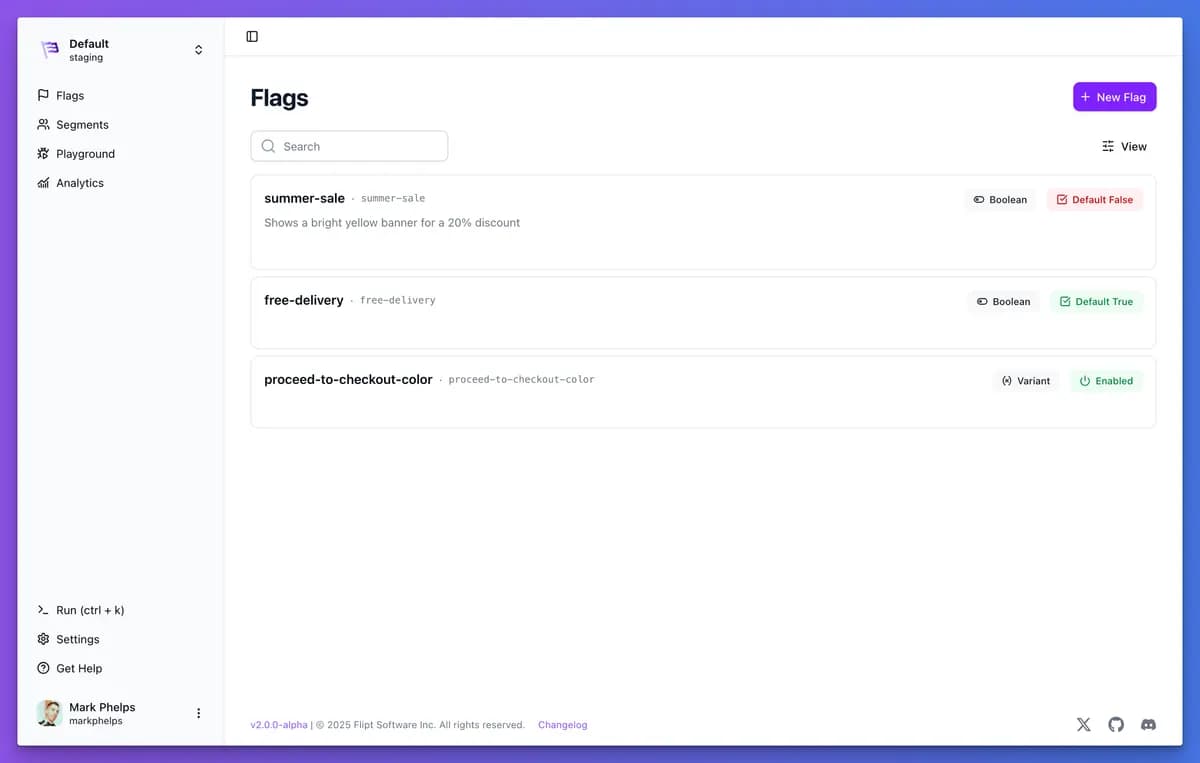
A self-hosted feature management platform that stores feature flags in Git and manages multi-environment delivery through a web UI, APIs, and real-time updates.
- Backend
- Full stack
- DevOps
- Automation
- Collaboration
- Web
- CLI
- API/SDK
- Browser
- Linux
- Self-hostable
- Runs locally
- Docker supported
- Popularity
- 4.9k Stars
- GitHub stars
- Recent activity
- 10/1/2026
- Updated in the last 30 days
- License
- NOASSERTION
- Review the terms yourself
Why it matters
We look beyond stars: what problem it solves, whether it creates real utility, and what makes its approach worth noticing.
Problem
Feature flags are typically stored in separate databases or dedicated admin panels, isolating them from standard Git workflows and making configuration changes hard to track.
Practical value
Stores feature flags as code in Git while providing a Web UI and real-time updates, enabling multi-environment releases and version control synchronized with code.
Innovation / differentiation
Shifts from a traditional database-centric architecture to a Git-native model, integrating feature flag branching, merging, and reviews directly into version control.
Leverage potential
Deploys as a single binary with zero external database dependencies, pushing real-time configuration updates to SDKs via SSE streaming APIs.
Why now
GitOps practices are gaining traction among engineering teams, increasing the demand for treating configurations and flags as part of code review workflows.
Community activity
In the last 90 days there were 22 new issues and 486 pull requests; the bounded issue/PR samples include 15 issue authors and 5 PR contributors, with at least 3 releases.
Maintainer responsiveness
The 22-issue window sample had a 82% close rate, and the 99-pull-request sample had a 95% merge rate. Maintainer-comment observations covered only 5% of that issue sample, so response rate and first-response speed are not reported.
Key highlights
- Store feature flags in your own Git repositories with full history
- Map environments to Git branches, directories, or separate repositories
- Provide a web UI, APIs, and Server-Sent Events for real-time updates
Quick start
How it is installed, how hard it is, and where to start.
Where it runs
Docker
Difficulty
Easy — follow the steps
- 01For a local trial, install Flipt v2 as documented or use the official Docker image.
- 02Run
docker run --rm -p 8080:8080 -p 9000:9000 -t docker.flipt.io/flipt/flipt:v2. - 03Open
http://127.0.0.1:8080/, then configure Git repositories and environment mappings using the project documentation.
Best for
- Teams that want data on their own servers
- Developers who want to try it on their machine
- People who prefer Docker deploys
More about it
Flipt v2 treats feature flags as Git-managed configuration rather than keeping flag state only in a separate database. Its README documents environments mapped to branches, directories, or repositories, along with Git history, review workflows, environment isolation, a web UI, Server-Sent Events for real-time updates, and self-hosting. It can run as a single binary or through Docker, making it relevant to engineering teams that already use GitOps or want feature-flag changes closer to their code review process.
Sources
Each field shows its status and source — expand to review.
12 · Expand
Sources
Each field shows its status and source — expand to review.
capability tags
Verifiedautomation, collaboration
Source: manual_curator · README manually reviewed for release curation · 8/17/2026
Latest release
Verifiedv2.13.0
Source: GitHub API · latest_release=v2.13.0 · 10/1/2026
License
VerifiedNOASSERTION
Source: GitHub API · license.spdx_id=NOASSERTION · 10/1/2026
needs api key
VerifiedNo
Source: manual_curator · README manually reviewed for release curation · 8/17/2026
One-liner
Verified{"en":"A self-hosted feature management platform that stores feature flags in Git and manages multi-environment delivery through a web UI, APIs, and real-time updates.","zh":"把功能开关存进 Git,并通过 Web UI、API 和实时更新机制管理多环境发布的自托管功能管理平台。"}
Source: manual_curator · README manually reviewed for release curation · 8/17/2026
Platforms
Verifiedbrowser, linux
Source: manual_curator · README manually reviewed for release curation · 8/17/2026
Category hint
Inferred from materialssecurity
Source: Project README · hint=security · 8/17/2026
product forms
Verifiedweb, cli, api_sdk
Source: manual_curator · README manually reviewed for release curation · 8/17/2026
role tags
Verifiedbackend, fullstack, devops
Source: manual_curator · README manually reviewed for release curation · 8/17/2026
supports docker
VerifiedYes
Source: Repository file · dockerfile=true; compose=true · 10/1/2026
supports local
VerifiedYes
Source: manual_curator · README manually reviewed for release curation · 8/17/2026
supports self host
VerifiedYes
Source: manual_curator · README manually reviewed for release curation · 8/17/2026
Related projects
Other verified projects matched by category, capabilities, and intended roles.
massing
Open-source, self-hosted, IFC-native AEC platform featuring in-browser BIM modeling, a general contractor portal, and development proforma tools.
openai-agents-python
A Python framework by OpenAI for building multi-agent workflows, supporting text, voice, and sandbox-based agent applications.
compose
Docker’s official CLI tool for defining and running multi-container applications from a Compose file.
WSL
Windows Subsystem for Linux allows you to run Linux command-line tools and applications directly on Windows without the overhead of a traditional virtual machine.
opencodex
A universal local proxy that enables the use of any LLM, such as Claude, Gemini, or DeepSeek, within Codex and Claude Code, while managing ChatGPT account pools.
cli-printing-press
Automatically generates agent-optimized Go CLI tools and MCP servers by reading API documentation or sniffing web traffic.