
scanopyOps & cloud
scanopy
A network documentation platform that continuously discovers and maps topology, hosts, workloads, and application dependencies through scheduled scans.
- DevOps
- Operations
- Monitoring / Observability
- Data analysis
- Web
- Browser
- Self-hostable
- Runs locally
- Docker supported
- Popularity
- 5.8k Stars
- GitHub stars
- Recent activity
- 10/2/2026
- Updated in the last 30 days
- License
- AGPL-3.0
- Strong copyleft
Why it matters
We look beyond stars: what problem it solves, whether it creates real utility, and what makes its approach worth noticing.
Problem
Addresses the issue of network documentation becoming stale and disconnected from the actual infrastructure state due to manual maintenance.
Practical value
Automates the generation of multi-dimensional views through scheduled scans, significantly reducing the manual effort required for mapping network architecture and dependencies.
Innovation / differentiation
Integrates network discovery with visualization, enabling automated mapping from physical to application layers without requiring device-specific agents.
Leverage potential
Supports multiple export formats and provides an API, facilitating integration into existing operational workflows or as a source of truth.
Why now
The demand for automated asset visualization is growing alongside the increasing complexity of infrastructure and the widespread adoption of cloud-native environments.
Community activity
In the last 90 days there were 33 new issues and 76 pull requests; the bounded issue/PR samples include 19 issue authors and 4 PR contributors, with at least 17 releases.
Maintainer responsiveness
The 33-issue window sample had a 73% close rate, and the 76-pull-request sample had a 80% merge rate. Maintainer-response observations covered 79% of that issue sample, with a 85% response rate and median first response of 3.5 days.
Key highlights
- Discover hosts, services, and network relationships through scheduled scans
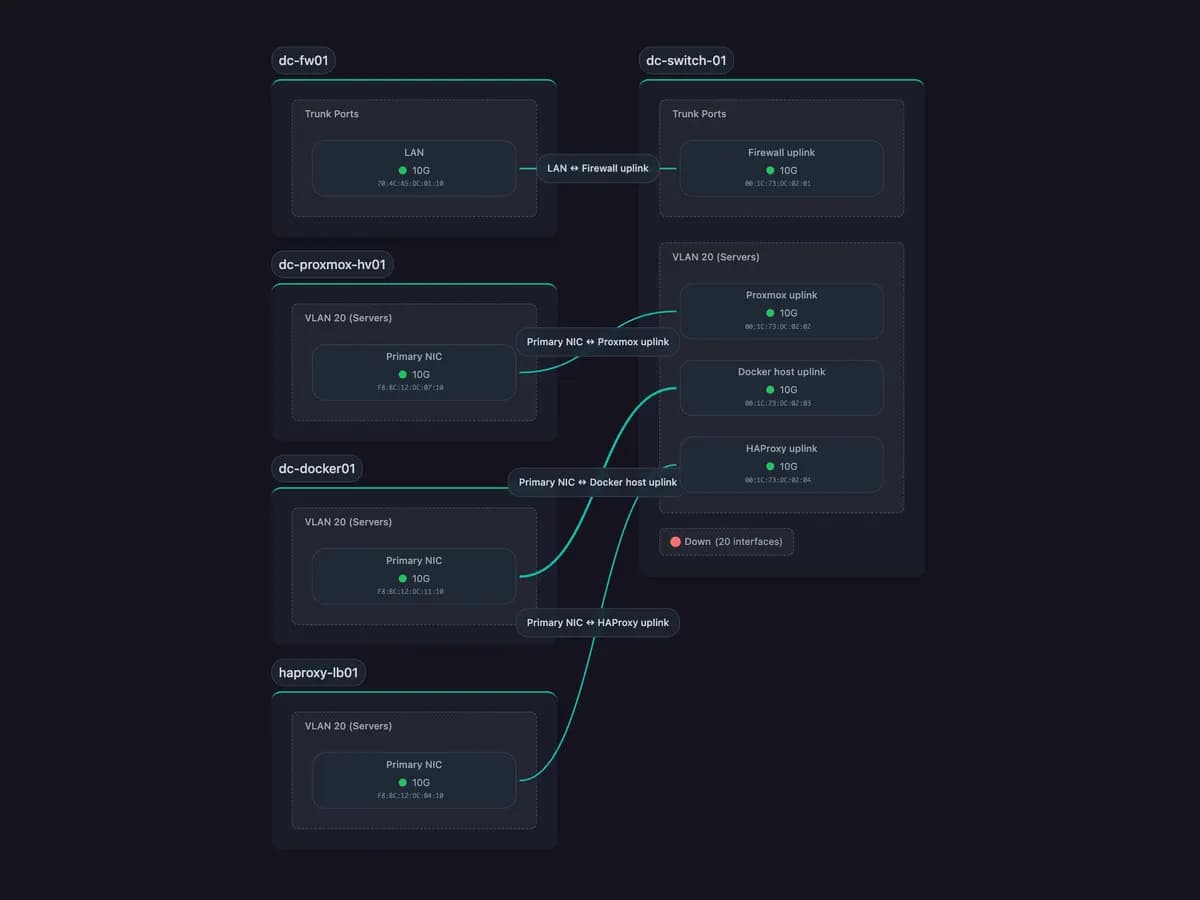
- Produce L2, L3, workload, and application-dependency views from each scan
- Support distributed scanning plus Docker and SNMP integrations
Quick start
How it is installed, how hard it is, and where to start.
Where it runs
Docker
Difficulty
Medium — some setup needed
- 01Download the docker-compose.yml file provided by the project.
- 02Run
docker compose up -dto start the Scanopy service. - 03Open port 60072 on the server in a browser and create the local account.
- 04Wait for the first scan, then configure additional segments, SNMP, or Docker discovery for the environment.
Best for
- Teams that want data on their own servers
- Developers who want to try it on their machine
- People who prefer Docker deploys
More about it
Scanopy replaces manually maintained network diagrams with automatic discovery. A scanning daemon inspects the current infrastructure on a schedule and produces four views from the same scan: L2 physical topology, L3 logical networking, workloads, and application dependencies. The goal is to document what is actually running instead of preserving a static drawing that drifts over time.
The project includes more than 230 service definitions for databases, web servers, containers, network infrastructure, and enterprise applications. Multiple daemons can scan separate segments, while Docker and SNMP integrations add container and network-device discovery. Results can be exported as SVG, Mermaid, or Confluence content, and live views can be shared.
The self-hosted edition is licensed under AGPL-3.0 and has a Docker Compose quick start; a hosted Scanopy Cloud option is also available.
Sources
Each field shows its status and source — expand to review.
15 · Expand
Sources
Each field shows its status and source — expand to review.
capability tags
Verifiedmonitoring, data_analysis
Source: manual_curated · Manually curated from the verified project README; no AI draft. · 8/17/2026
editor note
Verified{"en":"It targets a specific operational problem: network documentation goes stale quickly. Because the model is rebuilt from scheduled discovery instead of redrawn manually, it is more useful for environments that mix multiple VLANs, sites, containers, and traditional network devices.","zh":"它解决的是“网络文档很快过期”这个具体问题:拓扑来自周期性扫描,而不是让运维人员反复重画。对多 VLAN、多站点、容器与传统网络设备混合的环境,比单纯画拓扑图更有持续维护价值。"}
Source: manual_curated · Manually curated from the verified project README; no AI draft. · 8/17/2026
how to use
Verified{"steps":[{"en":"Download the docker-compose.yml file provided by the project.","zh":"下载项目提供的 docker-compose.yml。"},{"en":"Run `docker compose up -d` to start the Scanopy service.","zh":"执行 `docker compose up -d` 启动 Scanopy 服务。"},{"en":"Open port 60072 on the server in a browser and create the local account.","zh":"浏览器访问服务器的 60072 端口并创建本地账户。"},{"en":"Wait for the first scan, then configure additional segments, SNMP, or Docker discovery for the environment.","zh":"等待首次扫描完成,再根据网络环境配置额外网段、SNMP 或 Docker 发现。"}],"installAt":"docker","difficulty":"medium"}
Source: manual_curated · Manually curated from the verified project README; no AI draft. · 8/17/2026
intro
Verified{"en":"Scanopy replaces manually maintained network diagrams with automatic discovery. A scanning daemon inspects the current infrastructure on a schedule and produces four views from the same scan: L2 physical topology, L3 logical networking, workloads, and application dependencies. The goal is to document what is actually running instead of preserving a static drawing that drifts over time.\n\nThe project includes more than 230 service definitions for databases, web servers, containers, network infrastructure, and enterprise applications. Multiple daemons can scan separate segments, while Docker and SNMP integrations add container and network-device discovery. Results can be exported as SVG, Mermaid, or Confluence content, and live views can be shared.\n\nThe self-hosted edition is licensed under AGPL-3.0 and has a Docker Compose quick start; a hosted Scanopy Cloud option is also available.","zh":"Scanopy 用自动发现替代手工维护的网络拓扑图。一个扫描守护进程按照计划探测当前基础设施,并从同一次扫描生成 L2 物理拓扑、L3 逻辑网络、工作负载和应用依赖四类视图,用来反映实际运行状态而不是静态绘图文件。\n\n项目内置 230 多种服务定义,可识别数据库、Web 服务、容器、网络设备和企业应用;也支持跨网段部署多个扫描守护进程,并通过 Docker 与 SNMP 获取更多主机和网络硬件信息。生成结果可以导出为 SVG、Mermaid 或 Confluence 内容,也可以提供实时共享视图。\n\n自托管版本采用 AGPL-3.0,并提供 Docker Compose 快速启动;另外也有托管的 Scanopy Cloud。"}
Source: manual_curated · Manually curated from the verified project README; no AI draft. · 8/17/2026
Latest release
Verifiedv0.17.18
Source: GitHub API · latest_release=v0.17.18 · 10/2/2026
License
VerifiedAGPL-3.0
Source: GitHub API · license.spdx_id=AGPL-3.0 · 10/2/2026
needs api key
VerifiedNo
Source: manual_curated · Manually curated from the verified project README; no AI draft. · 8/17/2026
One-liner
Verified{"en":"A network documentation platform that continuously discovers and maps topology, hosts, workloads, and application dependencies through scheduled scans.","zh":"通过定时扫描自动生成并持续更新网络拓扑、主机、工作负载和应用依赖视图的网络文档平台。"}
Source: manual_curated · Manually curated from the verified project README; no AI draft. · 8/17/2026
Platforms
Verifiedbrowser
Source: manual_curated · Manually curated from the verified project README; no AI draft. · 8/17/2026
Category hint
Inferred from materialsai-apps
Source: Project README · hint=ai-apps · 8/14/2026
product forms
Verifiedweb
Source: manual_curated · Manually curated from the verified project README; no AI draft. · 8/17/2026
role tags
Verifieddevops, operations
Source: manual_curated · Manually curated from the verified project README; no AI draft. · 8/17/2026
supports docker
VerifiedYes
Source: Repository file · dockerfile=true; compose=true · 10/2/2026
supports local
VerifiedYes
Source: manual_curated · Manually curated from the verified project README; no AI draft. · 8/17/2026
supports self host
VerifiedYes
Source: manual_curated · Manually curated from the verified project README; no AI draft. · 8/17/2026
Related projects
Other verified projects matched by category, capabilities, and intended roles.
grafana
An open-source monitoring and observability platform for querying, visualizing, alerting on, and understanding metrics and logs.
prometheus
A monitoring system that scrapes target metrics, queries them with PromQL, evaluates rules, and triggers alerts when configured conditions are met.
loki
A horizontally-scalable, highly-available, multi-tenant log aggregation system inspired by Prometheus.
terraform
Terraform is an infrastructure-as-code tool that manages the lifecycle of cloud and local resources using declarative configuration files.
databasus
A self-hosted database backup manager with scheduling, restore verification, multiple storage targets, retention policies, and notifications.
oneuptime
An open-source observability platform combining uptime monitoring, on-call alerting, incident response, status pages, logs, metrics, and traces.