
cactus-computeAI apps
needle
A small local-model Python package for tool calling and structured extraction, with offline inference, confidence thresholds, LoRA fine-tuning, and model export.
- Backend
- Data
- Automation
- Data analysis
- Library/framework
- Web
- macOS
- Linux
- Browser
- Runs locally
- Popularity
- 12.9k Stars
- GitHub stars
- Recent activity
- 10/1/2026
- Updated in the last 30 days
- License
- APACHE-2.0
- Permissive
Why it matters
We look beyond stars: what problem it solves, whether it creates real utility, and what makes its approach worth noticing.
Problem
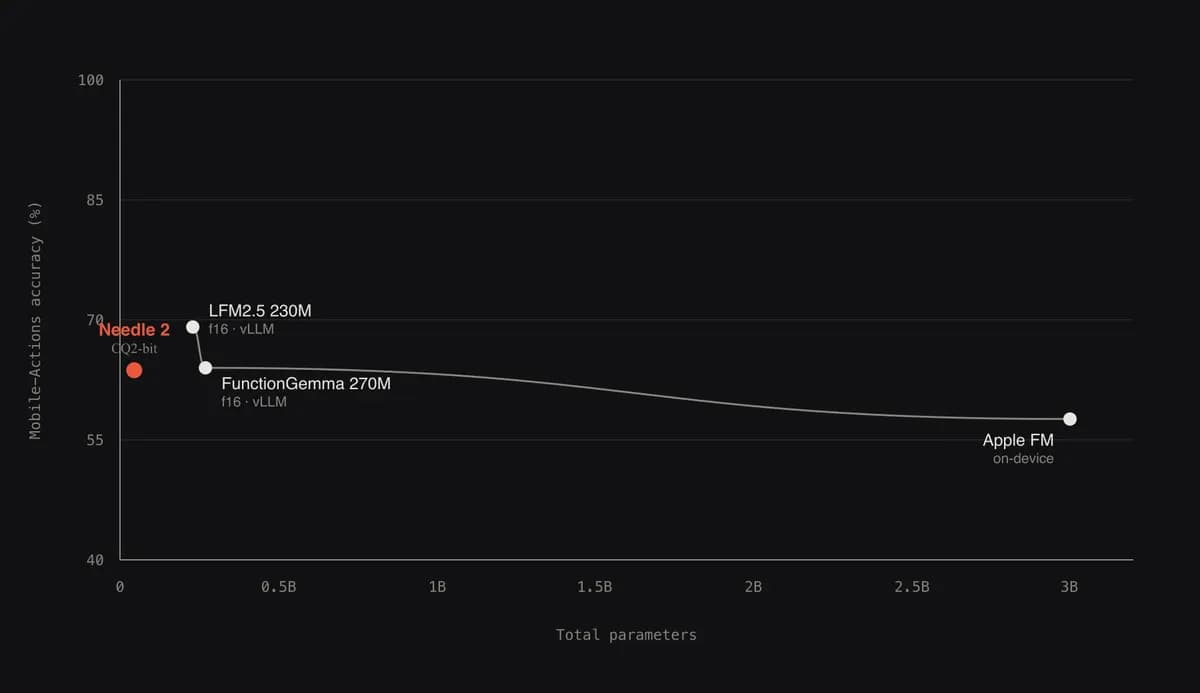
Addresses the challenge of deploying language models on severely resource-constrained edge devices by offering a 45M-parameter model consuming about 28MB of RAM for tool calling and extraction.
Practical value
Provides practical utility through a self-contained binary and Python package supporting offline inference, confidence gating, tool retrieval, and LoRA fine-tuning via straightforward APIs.
Innovation / differentiation
Innovates with a Simple Attention Network architecture combining Hadamard MLPs, engram key-value memory, and byte-level grammar-constrained decoding for ultra-compact models.
Leverage potential
Enables high leverage through low-cost LoRA fine-tuning, synthetic data generation, and straightforward model export into single-file binaries.
Why now
Arrives at an opportune time as local AI and edge deployment demands surge, aligning well with the industry push for privacy-first, offline-capable small language models.
Community activity
In the last 90 days there were 58 new issues and 71 pull requests; the bounded issue/PR samples include 50 issue authors and 36 PR contributors, with 0 releases.
Maintainer responsiveness
The 58-issue window sample had a 90% close rate, and the 71-pull-request sample had a 58% merge rate. Maintainer-response observations covered 74% of that issue sample, with a 0% response rate and median first response of not enough data.
Key highlights
- Declare Python tools with decorators and receive structured tool-call arguments
- Extract typed structured data from text with Pydantic schemas
- Run core inference locally after the model is cached without network access
Quick start
How it is installed, how hard it is, and where to start.
Where it runs
Runs locally
Difficulty
Medium — some setup needed
- 01Install with
pip install cactus-needle; the first run fetches and caches the required inference engine or model resources. - 02Describe allowed Python functions with
@needle.tool, or define a Pydantic model and useextract()for structured extraction. - 03Set confidence thresholds and validate arguments in real automation; use the project’s LoRA fine-tuning and export workflow only when adaptation to your own tools is needed.
Best for
- Developers who want to try it on their machine
More about it
Needle 2 combines a small tool-calling model, its inference engine, and a Python API in one package. Python functions can be declared as tools with decorators so the model selects a function and produces structured arguments, while Pydantic models can be used for structured extraction from text. After the model and engine are fetched and cached, core inference does not require network access. The project also includes response confidence scores, tool retrieval, a local playground, and LoRA fine-tuning and export workflows. Optional synthetic-data generation uses an external model API, but that is not required for core inference.
Sources
Each field shows its status and source — expand to review.
13 · Expand
Sources
Each field shows its status and source — expand to review.
capability tags
Verifiedautomation, data_analysis
Source: manual_curated · Manually curated from the verified project README; no in-app AI draft. · 8/17/2026
editor note
Verified{"en":"Its natural fit is not general chat but bounded tool selection, argument filling, and structured extraction in local or device-oriented applications. A small model reduces resource demands, but real business actions should still be protected by confidence thresholds and application-side validation.","zh":"它的优势场景不是通用聊天,而是设备端或本地应用中范围明确的工具选择、参数填写和结构化提取。小模型能降低资源占用,但真正接入业务动作前仍应利用置信度阈值和应用侧校验兜底。"}
Source: manual_curated · Manually curated from the verified project README; no in-app AI draft. · 8/17/2026
how to use
Verified{"steps":[{"en":"Install with `pip install cactus-needle`; the first run fetches and caches the required inference engine or model resources.","zh":"用 `pip install cactus-needle` 安装包;首次使用会获取并缓存所需推理引擎或模型资源。"},{"en":"Describe allowed Python functions with `@needle.tool`, or define a Pydantic model and use `extract()` for structured extraction.","zh":"用 `@needle.tool` 描述允许调用的 Python 函数,或定义 Pydantic 模型后调用 `extract()` 做结构化提取。"},{"en":"Set confidence thresholds and validate arguments in real automation; use the project’s LoRA fine-tuning and export workflow only when adaptation to your own tools is needed.","zh":"在真实自动化中设置置信度阈值和参数校验;需要针对自有工具优化时,再使用项目的 LoRA 微调与导出流程。"}],"installAt":"local","difficulty":"medium"}
Source: manual_curated · Manually curated from the verified project README; no in-app AI draft. · 8/17/2026
intro
Verified{"en":"Needle 2 combines a small tool-calling model, its inference engine, and a Python API in one package. Python functions can be declared as tools with decorators so the model selects a function and produces structured arguments, while Pydantic models can be used for structured extraction from text. After the model and engine are fetched and cached, core inference does not require network access. The project also includes response confidence scores, tool retrieval, a local playground, and LoRA fine-tuning and export workflows. Optional synthetic-data generation uses an external model API, but that is not required for core inference.","zh":"Needle 2 把小型工具调用模型、推理引擎和 Python API 放在同一套包中。安装后可以用装饰器把 Python 函数声明成工具,让模型选择函数并生成结构化参数;也可以用 Pydantic 模型从文本中提取结构化数据。模型和引擎首次获取并缓存后,核心推理不依赖网络。项目还提供置信度分数、工具检索、本地 Playground,以及 LoRA 微调和导出流程。可选的数据合成功能需要额外的模型 API,但这不是核心推理的必需条件。"}
Source: manual_curated · Manually curated from the verified project README; no in-app AI draft. · 8/17/2026
License
VerifiedApache-2.0
Source: GitHub API · license.spdx_id=Apache-2.0 · 10/1/2026
needs api key
VerifiedNo
Source: manual_curated · Manually curated from the verified project README; no in-app AI draft. · 8/17/2026
One-liner
Verified{"en":"A small local-model Python package for tool calling and structured extraction, with offline inference, confidence thresholds, LoRA fine-tuning, and model export.","zh":"面向本地工具调用和结构化提取的小型模型 Python 包,支持离线推理、置信度阈值、LoRA 微调与模型导出。"}
Source: manual_curated · Manually curated from the verified project README; no in-app AI draft. · 8/17/2026
Platforms
Verifiedmacos, linux, browser
Source: manual_curated · Manually curated from the verified project README; no in-app AI draft. · 8/17/2026
Category hint
VerifiedEdge AI model
Source: Project README · Description: '14MB foundation model for tiny devices' and 'tool calling for tiny devices', indicating edge deployment. · 8/14/2026
product forms
Verifiedlibrary_framework, web
Source: manual_curated · Manually curated from the verified project README; no in-app AI draft. · 8/17/2026
role tags
Verifiedbackend, data
Source: manual_curated · Manually curated from the verified project README; no in-app AI draft. · 8/17/2026
supports local
VerifiedYes
Source: manual_curated · Manually curated from the verified project README; no in-app AI draft. · 8/17/2026
supports self host
VerifiedNo
Source: manual_curated · Manually curated from the verified project README; no in-app AI draft. · 8/17/2026
Related projects
Other verified projects matched by category, capabilities, and intended roles.
ragflow
An open-source RAG engine fusing deep document understanding and agent capabilities to build grounded context layers for LLMs.
ouroboros
Ouroboros is an open-source, general-purpose AI agent with durable cross-restart memory that coordinates specialist swarms and rewrites its own implementation.
LobsterAI
A desktop agent for local files, terminal, browser, and office workflows with multi-agent setup, skills, MCP, scheduled tasks, and IM remote control.
project-pegaprox
A self-hosted multi-cluster management panel for Proxmox VE covering VM/container operations, monitoring, backups, access control, and automation; XCP-ng support remains Tech Preview.
agentconnect
An open-source multi-agent platform connecting AI runtimes to chat platforms and GitHub workflows.
sutando
An open-source local AI agent that responds via voice and screen by day, and runs an autonomous build loop by night.