
liam-hqData & analytics
liam
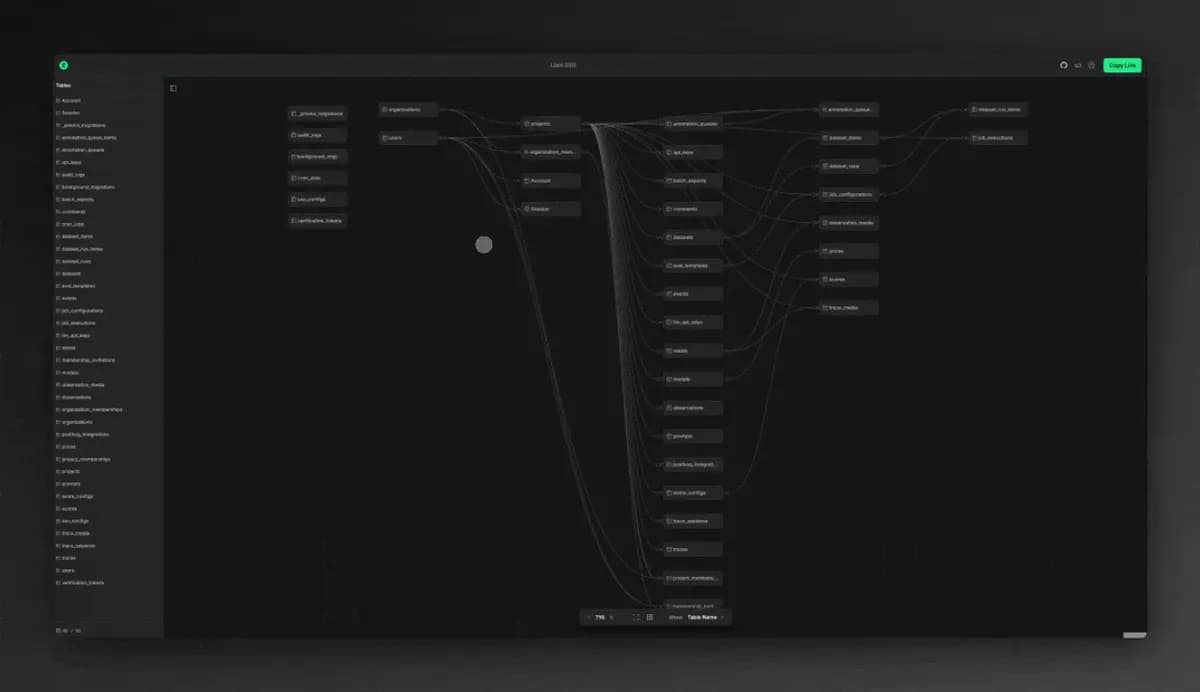
A tool that generates interactive ER diagrams from existing database schemas through public-repository links or a CLI workflow for private repositories.
- Backend
- Data
- Database
- Data analysis
- Web
- CLI
- Browser
- Runs locally
- Popularity
- 5.1k Stars
- GitHub stars
- Recent activity
- 9/24/2026
- Updated in the last 30 days
- License
- APACHE-2.0
- Permissive
Why it matters
We look beyond stars: what problem it solves, whether it creates real utility, and what makes its approach worth noticing.
Problem
Database schema documentation often lags behind code changes, making manual ER diagram maintenance time-consuming and error-prone.
Practical value
Visualizing public repository schemas via URL modification is highly convenient, while the CLI tool effectively addresses secure access for private projects.
Innovation / differentiation
Deeply integrating ER diagram generation with repository links offers a lightweight approach to Docs-as-Code visualization.
Leverage potential
It significantly lowers the barrier for teams to understand complex database structures, which is particularly useful for code reviews and onboarding.
Why now
With the prevalence of microservices and frequent database schema changes, the demand for automated documentation tools is on the rise.
Community activity
In the last 90 days there were 2 new issues and 23 pull requests; the bounded issue/PR samples include 2 issue authors and 0 PR contributors, with at least 0 releases.
Maintainer responsiveness
The 2-issue window sample had a 100% close rate, and the 23-pull-request sample had a 22% merge rate. Maintainer-comment observations covered only 0% of that issue sample, so response rate and first-response speed are not reported.
Key highlights
- Generate ER diagrams automatically from existing database schemas
- Explore diagrams with pan, zoom, and filtering controls
- Open public GitHub schemas by rewriting the file URL for the hosted viewer
Quick start
How it is installed, how hard it is, and where to start.
Where it runs
Cloud / hosted
Difficulty
Easy — follow the steps
- 01For a public repository, first locate the database schema file on GitHub.
- 02Prefix the original URL with liambx.com/erd/p/ to open the generated ER diagram.
- 03For a private repository, run
npx @liam-hq/cli initand follow the interactive local setup. - 04Use zoom, pan, and filtering in the generated view to inspect table relationships.
Best for
- Developers who want to try it on their machine
More about it
Liam ERD reverse-engineers existing database schemas into interactive entity-relationship diagrams. The generated view supports panning, zooming, and filtering, allowing teams to explore table relationships without maintaining a separate manually drawn schema diagram.
For public GitHub repositories, a schema-file URL can be prefixed with liambx.com/erd/p/ and opened directly in the hosted viewer. Private repositories can use the local interactive setup started with npx @liam-hq/cli init. The README also states that Liam is optimized for both smaller and larger projects and can handle schemas with more than 100 tables.
It fits development and data teams that already have a database schema but need a readable ERD generated from the source of truth.
Sources
Each field shows its status and source — expand to review.
13 · Expand
Sources
Each field shows its status and source — expand to review.
capability tags
Verifieddatabase, data_analysis
Source: manual_curated · Manually curated from the verified project README; no AI draft. · 8/17/2026
editor note
Verified{"en":"Liam has a narrow and useful job: when the schema already exists, the team does not need to redraw an ERD by hand. Public repositories can use a URL workflow while private repositories use the CLI, which is a good fit for schemas that change alongside the codebase.","zh":"Liam 的定位很清楚:Schema 已经存在时,不再让团队重复画 ER 图。公开仓库可以直接通过 URL 打开,私有仓库走 CLI,比较适合代码和数据库结构频繁变化的项目。"}
Source: manual_curated · Manually curated from the verified project README; no AI draft. · 8/17/2026
how to use
Verified{"steps":[{"en":"For a public repository, first locate the database schema file on GitHub.","zh":"公开仓库可先找到 GitHub 中的数据库 Schema 文件地址。"},{"en":"Prefix the original URL with liambx.com/erd/p/ to open the generated ER diagram.","zh":"在原地址前加入 liambx.com/erd/p/,直接打开生成的 ER 图。"},{"en":"For a private repository, run `npx @liam-hq/cli init` and follow the interactive local setup.","zh":"私有仓库运行 `npx @liam-hq/cli init`,按交互提示完成本地配置。"},{"en":"Use zoom, pan, and filtering in the generated view to inspect table relationships.","zh":"在生成的界面中使用缩放、平移和过滤查看表关系。"}],"installAt":"cloud","difficulty":"easy"}
Source: manual_curated · Manually curated from the verified project README; no AI draft. · 8/17/2026
intro
Verified{"en":"Liam ERD reverse-engineers existing database schemas into interactive entity-relationship diagrams. The generated view supports panning, zooming, and filtering, allowing teams to explore table relationships without maintaining a separate manually drawn schema diagram.\n\nFor public GitHub repositories, a schema-file URL can be prefixed with liambx.com/erd/p/ and opened directly in the hosted viewer. Private repositories can use the local interactive setup started with `npx @liam-hq/cli init`. The README also states that Liam is optimized for both smaller and larger projects and can handle schemas with more than 100 tables.\n\nIt fits development and data teams that already have a database schema but need a readable ERD generated from the source of truth.","zh":"Liam ERD 用于把已有数据库 Schema 反向转换成可交互的实体关系图。生成后的界面支持平移、缩放和过滤,用来浏览表与表之间的关系,而不是要求团队先手工维护一份独立的数据库图。\n\n公开 GitHub 仓库可以直接把 schema 文件地址改写为 liambx.com/erd/p/ 开头的链接并在线打开;私有仓库则可以通过 `npx @liam-hq/cli init` 启动本地交互式配置。项目 README 还明确提到它针对大型 Schema 做了优化,并以 100 张以上数据表作为可处理场景。\n\n它适合数据库结构已经存在、但缺少持续可读 ER 图的开发和数据团队。"}
Source: manual_curated · Manually curated from the verified project README; no AI draft. · 8/17/2026
Latest release
Verified@liam-hq/cli@0.7.24
Source: GitHub API · latest_release=@liam-hq/cli@0.7.24 · 10/3/2026
License
VerifiedApache-2.0
Source: GitHub API · license.spdx_id=Apache-2.0 · 10/3/2026
needs api key
VerifiedNo
Source: manual_curated · Manually curated from the verified project README; no AI draft. · 8/17/2026
One-liner
Verified{"en":"A tool that generates interactive ER diagrams from existing database schemas through public-repository links or a CLI workflow for private repositories.","zh":"从现有数据库 Schema 自动生成可交互 ER 图,并支持公开仓库链接与私有仓库 CLI 工作流。"}
Source: manual_curated · Manually curated from the verified project README; no AI draft. · 8/17/2026
Platforms
Verifiedbrowser
Source: manual_curated · Manually curated from the verified project README; no AI draft. · 8/17/2026
Category hint
Inferred from materialsbusiness
Source: Project README · hint=business · 8/14/2026
product forms
Verifiedweb, cli
Source: manual_curated · Manually curated from the verified project README; no AI draft. · 8/17/2026
role tags
Verifiedbackend, data
Source: manual_curated · Manually curated from the verified project README; no AI draft. · 8/17/2026
supports local
VerifiedYes
Source: manual_curated · Manually curated from the verified project README; no AI draft. · 8/17/2026
Related projects
Other verified projects matched by category, capabilities, and intended roles.
rill
A code-first business intelligence platform that uses SQL and YAML to define metrics and provides data access interfaces for AI agents.
clearml
A machine-learning development and MLOps platform for experiment tracking, remote orchestration, data versioning, and model workflows with hosted or self-hosted servers.
Apache DevLake
An engineering data platform that unifies sources such as GitHub, GitLab, Jira, Jenkins, and SonarQube for DORA and delivery analytics in Grafana.
Rath
A visual exploratory-data-analysis tool that recommends charts and insights while supporting manual exploration, data wrangling, and experimental causal analysis.
duck-ui
An open-source, browser-based DuckDB workbench featuring a SQL editor, notebooks, charts, and local AI assistance.
Dishylink
Open-source Starlink monitor for macOS, Windows, and browsers using the local dish API.