
oomol-labDeveloper tools
Open Connector
open-connector
An open-source agent connector gateway that keeps third-party app accounts behind a dedicated runtime and exposes actions through web, MCP, HTTP/OpenAPI, and SDK interfaces.
- Backend
- DevOps
- Security
- Automation
- API debugging
- Web
- API/SDK
- Browser
- Linux
- Self-hostable
- Runs locally
- Docker supported
- Popularity
- 5.9k Stars
- GitHub stars
- Recent activity
- 9/30/2026
- Updated in the last 30 days
- License
- APACHE-2.0
- Permissive
Why it matters
We look beyond stars: what problem it solves, whether it creates real utility, and what makes its approach worth noticing.
Problem
AI agents frequently need to connect with third-party applications like GitHub, Notion, and Slack, traditionally handling complex OAuth credentials directly and creating security risks. The project addresses API fragmentation by centralizing credentials and action execution into an independent gateway.
Practical value
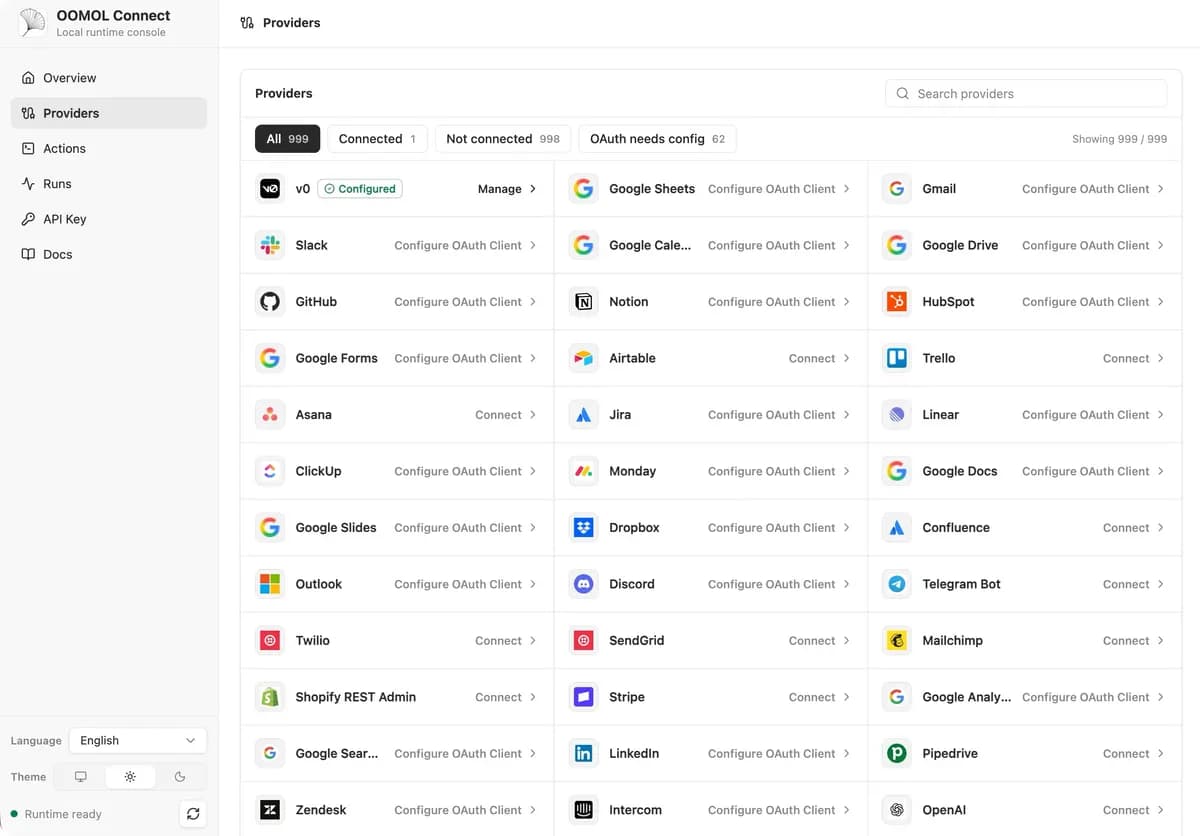
Provides over 10,000 prebuilt actions and a catalog of 1,000+ providers with integration via Web, MCP, HTTP/OpenAPI, and SDKs. Users can deploy via Docker, Node.js, Cloudflare, or hosted runtimes, making it practical to adopt into existing infrastructure.
Innovation / differentiation
Serving as an open-source alternative to Pipedream and Composio, it unifies credential management, runtime policy controls, action execution contracts, and MCP support within a single gateway to isolate agent processes from sensitive keys.
Leverage potential
Developers can provide multiple agents with access to various SaaS applications through a unified gateway interface, eliminating the need to write custom integration code for every single service.
Why now
With the rapid growth of AI agent applications, developers urgently need standardized infrastructure for securely calling external tools, making the timing of this project highly relevant.
Community activity
In the last 90 days there were 97 new issues and 499 pull requests; the bounded issue/PR samples include 46 issue authors and 26 PR contributors, with 23 releases.
Maintainer responsiveness
The 97-issue window sample had a 99% close rate, and the 96-pull-request sample had a 95% merge rate. Maintainer-response observations covered 43% of that issue sample, with a 7% response rate and median first response of 0.7 hours.
Key highlights
- Centralize API keys, OAuth2, custom credentials, and connection identities
- Control agent calls with action schemas, scopes, and allow/block policies
- Expose web console, MCP, HTTP/OpenAPI, and SDK interfaces
Quick start
How it is installed, how hard it is, and where to start.
Where it runs
Docker
Difficulty
Harder — CLI / server skills help
- 01Start the runtime with the provided Docker Compose setup, then open the local web console and API docs to verify the service.
- 02Add GitHub, Gmail, Notion, or other connections as needed; API-key integrations can be configured directly, while OAuth services require an upstream OAuth app first.
- 03Create runtime tokens and least-privilege policies before exposing approved actions to agents through MCP, HTTP/OpenAPI, or the SDK.
Best for
- Teams that want data on their own servers
- Developers who want to try it on their machine
- People who prefer Docker deploys
More about it
OpenConnector places a dedicated runtime between AI agents and external services such as GitHub, Gmail, Notion, Slack, and data systems. Credentials, OAuth flows, scopes, action schemas, runtime tokens, allow/block policies, and run logs stay behind the gateway, while agents receive only the interfaces and results needed for execution. It can be self-hosted with Docker or Node.js, deployed to Cloudflare Workers, and accessed through a web console, MCP, HTTP/OpenAPI, or the Connector SDK. Self-hosted OAuth integrations still require users to register their own OAuth applications and credentials with the upstream providers.
Sources
Each field shows its status and source — expand to review.
15 · Expand
Sources
Each field shows its status and source — expand to review.
capability tags
Verifiedautomation, security, api_debugging
Source: manual_curated · Manually curated from the verified project README; no in-app AI draft. · 8/17/2026
editor note
Verified{"en":"A separate credential boundary is easier to audit and constrain than handing many API keys directly to every agent. The tradeoff is operational ownership: self-hosters must manage OAuth apps, secrets, storage, and upgrades, and a listed connector does not mean zero-configuration access to every service.","zh":"相比把大量 API Key 直接塞给每个 Agent,这种独立凭据边界更容易审计和收敛权限。代价是自托管时要自己维护 OAuth App、密钥、存储和升级,不能把“有连接器”理解成“无需配置即可登录所有服务”。"}
Source: manual_curated · Manually curated from the verified project README; no in-app AI draft. · 8/17/2026
how to use
Verified{"steps":[{"en":"Start the runtime with the provided Docker Compose setup, then open the local web console and API docs to verify the service.","zh":"先用项目提供的 Docker Compose 启动运行时,打开本地 Web Console 和 API 文档确认服务可用。"},{"en":"Add GitHub, Gmail, Notion, or other connections as needed; API-key integrations can be configured directly, while OAuth services require an upstream OAuth app first.","zh":"按需要添加 GitHub、Gmail、Notion 等连接;API Key 可直接配置,OAuth 服务需要先在上游平台注册自己的 OAuth App。"},{"en":"Create runtime tokens and least-privilege policies before exposing approved actions to agents through MCP, HTTP/OpenAPI, or the SDK.","zh":"创建运行令牌和最小权限策略后,再通过 MCP、HTTP/OpenAPI 或 SDK 把允许的 Actions 暴露给 Agent。"}],"installAt":"docker","difficulty":"hard"}
Source: manual_curated · Manually curated from the verified project README; no in-app AI draft. · 8/17/2026
intro
Verified{"en":"OpenConnector places a dedicated runtime between AI agents and external services such as GitHub, Gmail, Notion, Slack, and data systems. Credentials, OAuth flows, scopes, action schemas, runtime tokens, allow/block policies, and run logs stay behind the gateway, while agents receive only the interfaces and results needed for execution. It can be self-hosted with Docker or Node.js, deployed to Cloudflare Workers, and accessed through a web console, MCP, HTTP/OpenAPI, or the Connector SDK. Self-hosted OAuth integrations still require users to register their own OAuth applications and credentials with the upstream providers.","zh":"OpenConnector 用一个独立运行时承接 AI Agent 与 GitHub、Gmail、Notion、Slack、数据库等外部服务之间的连接。账号凭据、OAuth、作用域、Action Schema、运行令牌、允许/阻止策略和调用日志都留在网关侧,Agent 只拿到执行所需的接口和结果。项目可以用 Docker 或 Node.js 自托管,也支持部署到 Cloudflare Workers,并提供 Web Console、MCP、HTTP/OpenAPI 与 Connector SDK。自托管 OAuth 服务时,用户仍需要自行向对应平台申请 OAuth App 和凭据。"}
Source: manual_curated · Manually curated from the verified project README; no in-app AI draft. · 8/17/2026
Latest release
Verifiedv1.8.0
Source: GitHub API · latest_release=v1.8.0 · 9/30/2026
License
VerifiedApache-2.0
Source: GitHub API · license.spdx_id=Apache-2.0 · 9/30/2026
needs api key
VerifiedNo
Source: manual_curated · Manually curated from the verified project README; no in-app AI draft. · 8/17/2026
One-liner
Verified{"en":"An open-source agent connector gateway that keeps third-party app accounts behind a dedicated runtime and exposes actions through web, MCP, HTTP/OpenAPI, and SDK interfaces.","zh":"把第三方应用账号连接集中在独立网关中的开源 Agent 连接器,可通过 Web、MCP、HTTP/OpenAPI 和 SDK 调用。"}
Source: manual_curated · Manually curated from the verified project README; no in-app AI draft. · 8/17/2026
Platforms
Verifiedbrowser, linux
Source: manual_curated · Manually curated from the verified project README; no in-app AI draft. · 8/17/2026
Category hint
Inferred from materialsai-apps
Source: Project README · hint=ai-apps · 8/15/2026
product forms
Verifiedweb, api_sdk
Source: manual_curated · Manually curated from the verified project README; no in-app AI draft. · 8/17/2026
role tags
Verifiedbackend, devops, security
Source: manual_curated · Manually curated from the verified project README; no in-app AI draft. · 8/17/2026
supports docker
VerifiedYes
Source: Repository file · dockerfile=true; compose=true · 9/30/2026
supports local
VerifiedYes
Source: manual_curated · Manually curated from the verified project README; no in-app AI draft. · 8/17/2026
supports self host
VerifiedYes
Source: manual_curated · Manually curated from the verified project README; no in-app AI draft. · 8/17/2026
Related projects
Other verified projects matched by category, capabilities, and intended roles.
microsandbox
A fast, local-first microVM runtime and library for running untrusted workloads.
nono
A zero-latency, zero-setup sandbox for AI agents that enforces least-privilege isolation for both the agent and its delegated tools.
cli-printing-press
Automatically generates agent-optimized Go CLI tools and MCP servers by reading API documentation or sniffing web traffic.
mcptoon
A lightweight MCP CLI client that reduces AI agent context usage by compressing tool manifests and execution results.
container
Apple’s command-line tool for running OCI Linux containers as lightweight virtual machines on Apple silicon Macs.
compose
Docker’s official CLI tool for defining and running multi-container applications from a Compose file.