
supabaseDeveloper tools
supabase
An open-source Postgres development platform offering auto-generated APIs, authentication, and real-time database subscriptions.
- Web
- CLI
- API/SDK
- Library/framework
- Browser
- Windows
- macOS
- Linux
- Self-hostable
- Runs locally
- Docker supported
- Popularity
- 110.9k Stars
- GitHub stars
- Recent activity
- 9/30/2026
- Updated in the last 30 days
- License
- APACHE-2.0
- Permissive
Why it matters
We look beyond stars: what problem it solves, whether it creates real utility, and what makes its approach worth noticing.
Problem
Addresses the recurring pain point of developers having to repeatedly build user authentication, database management, API layers, and real-time data distribution from scratch when creating full-stack applications.
Practical value
Directly reduces backend setup costs by wrapping PostgreSQL into a managed service and offering auto-generated REST/GraphQL endpoints, an authentication system, and client SDKs.
Innovation / differentiation
Integrates mature open-source components like PostgREST, GoTrue, and Realtime into a cohesive suite, offering an open-source alternative to closed-source backend platforms.
Leverage potential
Leverages the existing Postgres ecosystem and official client libraries across multiple languages to enable rapid frontend integration, reducing the effort needed to maintain separate backend services.
Why now
Launched amidst a growing demand for data sovereignty, open-source alternatives, and cloud-native backend services, aligning well with current technical trends.
Community activity
In the last 90 days there were 339 new issues and 2643 pull requests; the bounded issue/PR samples include 85 issue authors and 39 PR contributors, with 2 releases.
Maintainer responsiveness
The 98-issue window sample had a 78% close rate, and the 82-pull-request sample had a 72% merge rate. Maintainer-comment observations covered only 7% of that issue sample, so response rate and first-response speed are not reported.
Key highlights
- Hosted PostgreSQL database with vector extensions and AI toolkit support
- Auto-generated REST and GraphQL APIs powered by PostgREST and pg_graphql
- Real-time WebSocket data streaming driven by Postgres replication logs
Quick start
How it is installed, how hard it is, and where to start.
Where it runs
Cloud / hosted
Difficulty
Easy — follow the steps
- 01Visit the Supabase website and log in to the Dashboard console.
- 02Create a new project, setting the project name, database password, and hosting region.
- 03Use the Table Editor in the Dashboard to define schemas or run SQL scripts in the SQL Editor.
- 04Go to Project Settings to copy the Project URL and API keys (anon/public key).
- 05Import the Supabase SDK for your language in your application and initialize it to read and write data.
Best for
- Teams that want data on their own servers
- Developers who want to try it on their machine
- People who prefer Docker deploys
More about it
Supabase is an open-source Backend-as-a-Service (BaaS) platform centered on the PostgreSQL relational database. It bundles permissively licensed open-source components to provide a Firebase-like workflow while preserving the query capabilities and flexibility of a standard Postgres database.
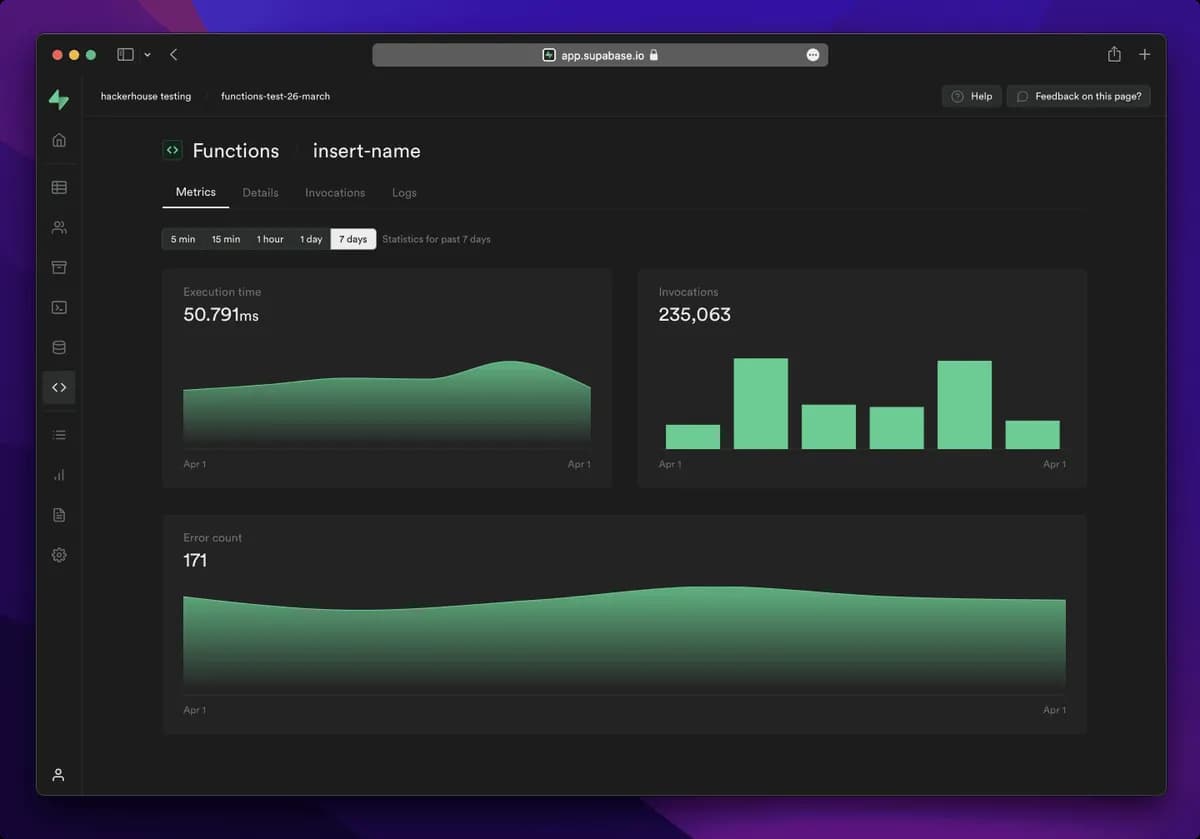
Architecturally, Supabase links several distinct server modules: PostgREST translates Postgres schemas into RESTful APIs, pg_graphql exposes a GraphQL endpoint, GoTrue manages user authentication and JWT tokens, and Realtime monitors database replication logs to broadcast table updates over WebSockets.
Beyond database management, Supabase offers S3-compatible object storage integrated with Postgres RLS policies, Edge Functions, and vector search with pgvector for AI applications. It can be used via its managed cloud service, spun up locally using the CLI, or self-hosted on custom infrastructure via Docker.
Sources
Each field shows its status and source — expand to review.
12 · Expand
Sources
Each field shows its status and source — expand to review.
capability tags
VerifiedSource: admin_cms · cms editor · 8/15/2026
Latest release
Verifiedv1.26.08
Source: GitHub API · latest_release=v1.26.08 · 9/30/2026
License
VerifiedApache-2.0
Source: GitHub API · license.spdx_id=Apache-2.0 · 9/30/2026
needs api key
VerifiedNo
Source: admin_cms · cms editor · 8/15/2026
One-liner
Verified{"en":"An open-source Postgres development platform offering auto-generated APIs, authentication, and real-time database subscriptions.","zh":"基于 PostgreSQL 的开源后端即服务平台,提供自动生成的 API、用户认证与实时数据订阅。"}
Source: admin_cms · cms editor · 8/15/2026
Platforms
Verifiedbrowser, windows, macos, linux
Source: admin_cms · cms editor · 8/15/2026
Category hint
Inferred from materialsai-apps
Source: Project README · hint=ai-apps · 8/15/2026
product forms
Verifiedweb, cli, api_sdk, library_framework
Source: admin_cms · cms editor · 8/15/2026
role tags
VerifiedSource: admin_cms · cms editor · 8/15/2026
supports docker
VerifiedYes
Source: Repository file · dockerfile=true; compose=true · 9/30/2026
supports local
VerifiedYes
Source: admin_cms · cms editor · 8/15/2026
supports self host
VerifiedYes
Source: admin_cms · cms editor · 8/15/2026
Related projects
Other verified projects matched by category, capabilities, and intended roles.
claude-code
An agentic coding tool for the terminal that understands codebases, handles routine development tasks, explains code, and works with Git workflows.
spec-kit
An open-source CLI toolkit for Spec-Driven Development that guides AI coding agents through structured specification, planning, and code generation steps.
llama.cpp
A lightweight LLM inference engine implemented in C/C++, supporting various hardware backends and model quantization.
codex
OpenAI’s coding agent that runs locally, with terminal, IDE, and desktop-app entry points.
graphify
Convert codebases, docs, and configs into a queryable knowledge graph for AI coding assistants
playwright
A cross-browser automation framework for testing and AI agent control, supporting Chromium, Firefox, and WebKit.