William-Lu-stackOps & cloud
Flawless
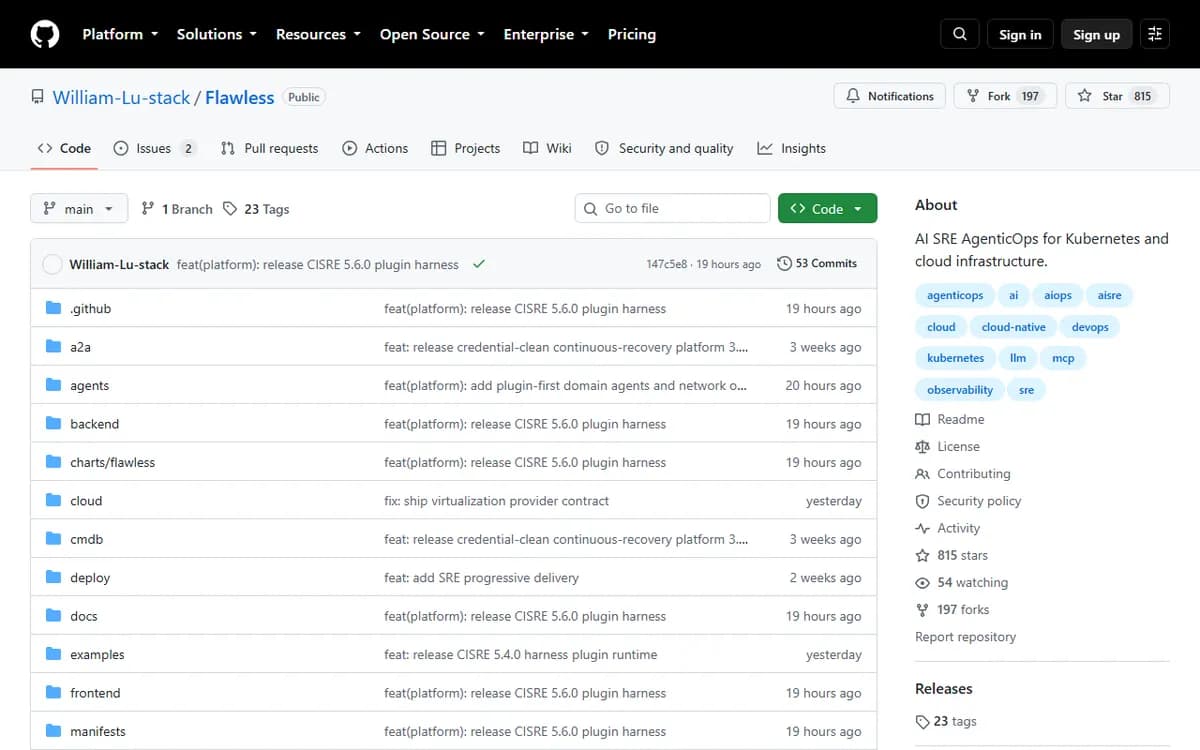
An enterprise Agentic SRE platform for Kubernetes and cloud infrastructure that automates fault discovery, evidence gathering, diagnosis, controlled execution, and recovery verification.
- DevOps
- Backend
- Security
- Automation
- Monitoring / Observability
- Testing
- Web
- Linux
- macOS
- Windows
- Browser
- Self-hostable
- Runs locally
- Docker supported
- Needs API key
- Popularity
- 777 Stars
- GitHub stars
- Recent activity
- 8/14/2026
- Maintenance status unclear
- License
- NOASSERTION
- Review the terms yourself
Why it matters
We look beyond stars: what problem it solves, whether it creates real utility, and what makes its approach worth noticing.
Problem
The platform addresses the lack of trust in models, bypassed approval gates, and insufficient evidence chains in IT infrastructure operations.
Practical value
It provides an auditable closed loop from risk discovery and diagnosis to controlled change and verification, ensuring practical applicability.
Innovation / differentiation
It introduces a plugin-first architecture and domain skill routing, decoupling LLM reasoning from deterministic execution boundaries.
Leverage potential
Through standardized plugin manifests and typed actions, it allows infrastructure teams to deliver ops capabilities without core modifications.
Why now
It arrives as enterprises adopt cloud-native operations and AI-assisted troubleshooting while maintaining strict security boundaries.
Community activity
In the last 90 days there were 5 new issues and 0 pull requests; the bounded issue/PR samples include 5 issue authors and 0 PR contributors, with 0 releases.
Maintainer responsiveness
The 5-issue window sample had a 0% close rate, and the 0-pull-request sample had a — merge rate. Maintainer-comment observations covered only 100% of that issue sample, so response rate and first-response speed are not reported.
Key highlights
- Closed-loop SRE workflow: Unifies risk discovery, evidence collection, root-cause diagnosis, controlled changes, and recovery verification into an audited loop.
- Domain Agents & plugin architecture: Features dedicated agents for Kubernetes, databases, VMs, and storage, extensible via manifests, providers, and skills.
- Strict safety gates & approvals: Blocks arbitrary command injection by requiring typed actions, blast radius evaluation, and human approval.
Quick start
How it is installed, how hard it is, and where to start.
Where it runs
Self-hosted (your own server)
Difficulty
Medium — some setup needed
- 01Set up and activate a Python virtual environment: python3 -m venv .venv && source .venv/bin/activate
- 02Install backend dependencies: python -m pip install -r requirements.txt
- 03Run backend test suite to verify kernel configuration: python -m pytest tests
- 04Start the backend local stack: python scripts/runlocalstack.py --host 127.0.0.1 --api-port 8080
- 05Navigate to the frontend directory, install dependencies, and start the development server: cd frontend/modern && npm ci && npm run dev
Best for
- Teams that want data on their own servers
- Developers who want to try it on their machine
- People who prefer Docker deploys
More about it
CISRE (Cloud Infrastructure Site Reliability Engine) is an enterprise-grade AgenticOps platform built for Kubernetes and cloud infrastructure. It connects risk discovery, evidence gathering, root-cause diagnosis, skill routing, change approval, controlled execution, and recovery verification into an audited workflow, overcoming typical AI ops pitfalls such as unsafe executions or unverified resolution claims.
The architecture adopts a "Everything is a Plugin" philosophy inspired by Harness orchestrations. Resource domains like Kubernetes, databases, VMs, storage, and networking integrate via modular Domain Agents, read-only Providers, domain Skills, and typed action catalogs without altering the core engine. AI models handle reasoning and planning while actual state mutations require strict typed action mapping and mandatory human approvals.
For safety and accountability, external plugins cannot gain direct high-privilege credentials or execute arbitrary Shell/SQL commands. CISRE uses append-only event journals, snapshot stores, and hash-chained session logs for full auditability, while Agent Trace redacts raw credentials and unmasked prompts to satisfy enterprise compliance requirements.
Sources
Each field shows its status and source — expand to review.
11 · Expand
Sources
Each field shows its status and source — expand to review.
capability tags
Verifiedautomation, monitoring, testing, security
Source: admin_cms · cms editor · 8/15/2026
License
VerifiedNOASSERTION
Source: GitHub API · license.spdx_id=NOASSERTION · 10/1/2026
needs api key
VerifiedYes
Source: admin_cms · cms editor · 8/15/2026
One-liner
Verified{"en":"An enterprise Agentic SRE platform for Kubernetes and cloud infrastructure that automates fault discovery, evidence gathering, diagnosis, controlled execution, and recovery verification.","zh":"面向 Kubernetes 与云基础设施的企业级 Agentic SRE 运维平台,贯穿风险发现、取证诊断、受控变更与恢复验证全闭环。"}
Source: admin_cms · cms editor · 8/15/2026
Platforms
Verifiedlinux, macos, windows, browser
Source: admin_cms · cms editor · 8/15/2026
Category hint
Inferred from materialsai-apps
Source: Project README · hint=ai-apps · 8/15/2026
product forms
Verifiedweb
Source: admin_cms · cms editor · 8/15/2026
role tags
Verifieddevops, backend, security
Source: admin_cms · cms editor · 8/15/2026
supports docker
VerifiedYes
Source: Repository file · dockerfile=true; compose=true · 10/1/2026
supports local
VerifiedYes
Source: admin_cms · cms editor · 8/15/2026
supports self host
VerifiedYes
Source: admin_cms · cms editor · 8/15/2026
Related projects
Other verified projects matched by category, capabilities, and intended roles.
OpenSandbox
An open-source sandbox platform for AI agents and code execution with Docker/Kubernetes runtimes, SDKs, CLI, and MCP integration.
terraform
Terraform is an infrastructure-as-code tool that manages the lifecycle of cloud and local resources using declarative configuration files.
oneuptime
An open-source observability platform combining uptime monitoring, on-call alerting, incident response, status pages, logs, metrics, and traces.
kftray
A desktop and TUI Kubernetes port-forward manager with automatic reconnection, multi-forward control, and TCP/UDP support.
Nova-Server
A self-hosted, censorship-resistant proxy server and admin panel for Linux VPS, supporting Xray-core, sing-box, Hysteria2, and AmneziaWG.
prometheus
A monitoring system that scrapes target metrics, queries them with PromQL, evaluates rules, and triggers alerts when configured conditions are met.